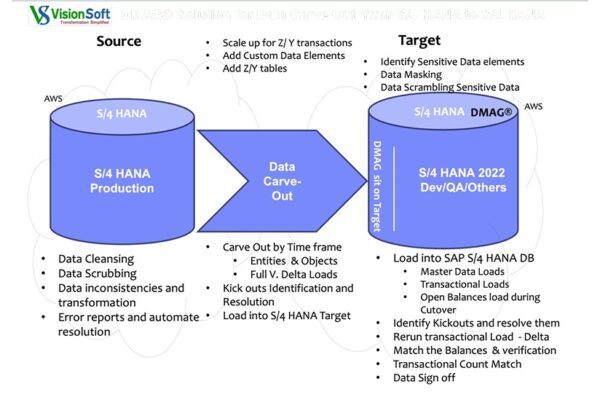
Organizations often require development, testing, training, and quality assurance environments that behave like real production systems. However, copying the entire production database into non-production environments can be expensive, time-consuming, and risky from a data privacy perspective. Data Carveout provides a smarter and more efficient approach by extracting only the relevant subset of data required for specific scenarios.
A data carveout is the selective extraction of master data, transactional data, and configuration data from a production system into development or testing environments. Instead of cloning the full system, carveouts focus on meaningful datasets such as a specific business process, region, product line, or time period. This allows teams to work with realistic data while significantly reducing system size, refresh time, and infrastructure costs.
Our DMAG®-powered Data Carveout framework enables organizations to create targeted datasets that support development, testing, analytics, and training activities. By applying governed selection rules and automated extraction techniques, the framework ensures that only relevant data is transferred into non-production environments. This targeted approach allows project teams to test real business scenarios without the overhead of maintaining full database copies.